



The Iron Age
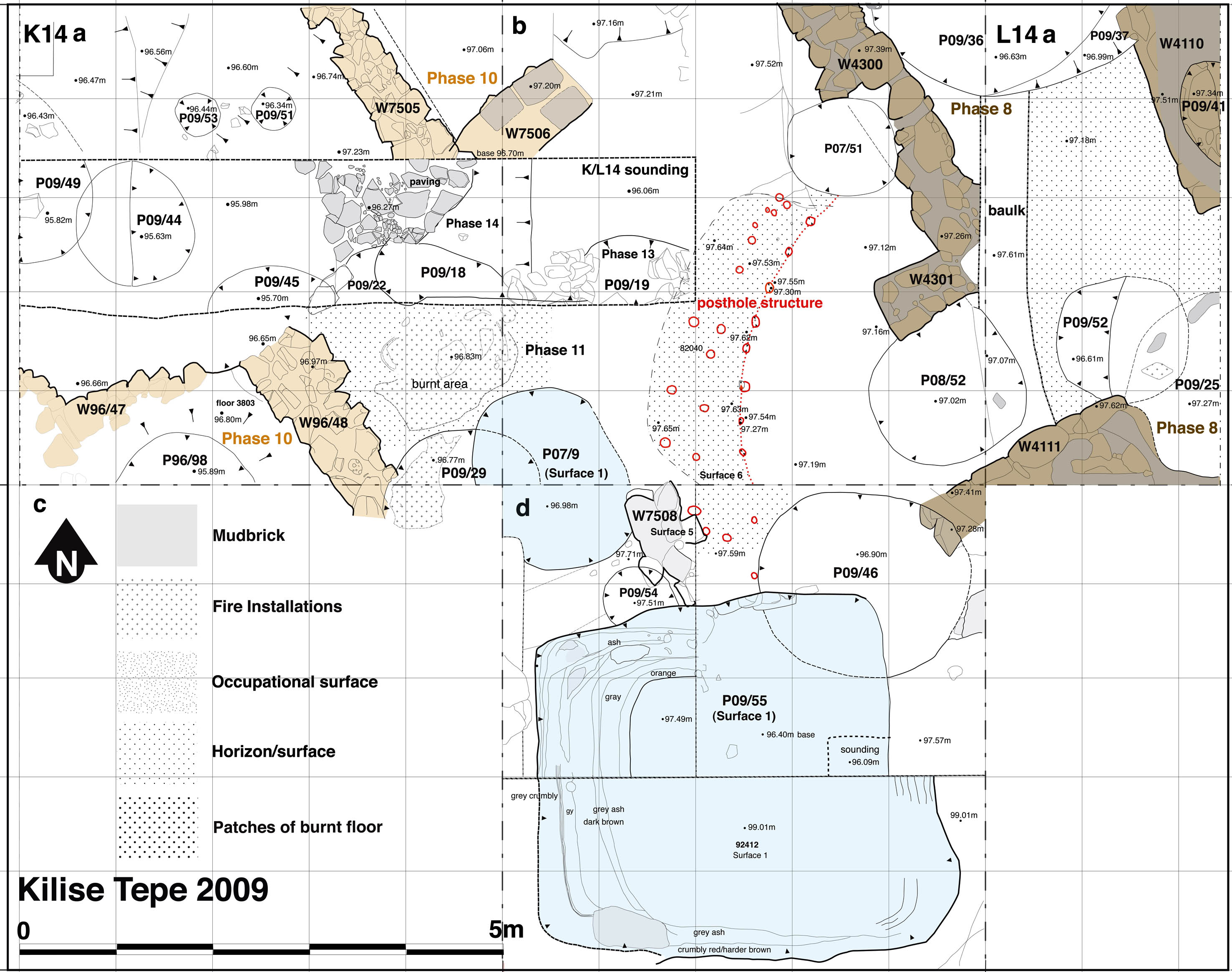 Plan of K14
 Click the map to see an enlarged version.
In 1995-1996 a sounding into Iron Age deposits south of the church foundations had encountered no architecture for a depth of 1.5 m, but rather an open space into which large storage pits had been sunk. Assuming that some associated building could not be too far away, we decided to enlarge this sounding to the east, to tie the sequence into some architecture. In the event the architecture remained elusive. The work in 2007-2011 has revealed four main stages in the formation of this part of the site. The latest stage of pre-Classical occupation is represented by an open space (called by us Surface 1) which hosted two or three small ovens, two or more deep circular storage pits, one very much larger rectangular storage pit in K14d with a capacity of about 35 cubic metres, and an even larger storage facility near the western edge of the tepe, which had previously been called a "ditch" but was now clearly a deep rectangular pit.
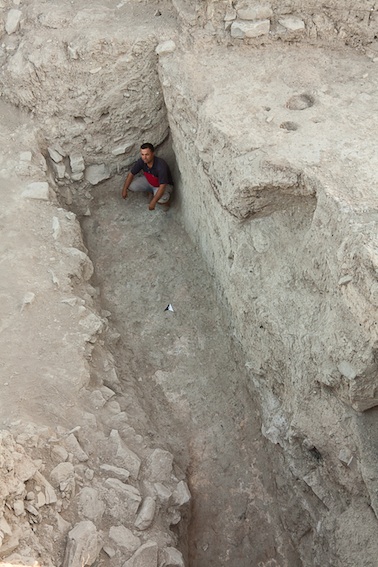 Massive Iron Age storage facility in I/J14
 (P11/11)
The date of these surfaces is hard to pin down, for want of enough good 14C samples from primary contexts. In these levels the ceramics are predominantly local, but also increasingly as time passes there are occasional imports or imitations of exotic wares, such as Black on Red or Bichrome, bearing witness to the re-establishment of cultural relations with the Mediterranean region. At present both Surfaces 3 and 4 seem likely to belong to the centuries immediately before Surface 1, so provisionally 900-700 BC.
Going further down, the third stage is a sequence of architectural phases sealed by the packing for Surface 4. The latest of these (Phase 5) is only present towards the west, and largely consists of a sequence of open air living areas, at times with storage pits or an oven, and probably protected from the sun by temporary shelters for which we found numerous post-holes. There are scrappy stone or mud-brick walls at different times, but for the most part the associated architecture must have been over towards the western edge of the mound, where part of a contemporary house was discovered in the 1990s. The connection between the two areas was entirely removed by the excavators of the massive rectangular storage pit much later at the time of Surface 1.
Phase 6 Immediately before the Phase 5 house and open area the whole area had been flattened except for a wall running across the space from north to south. East of this in the latest phase (6a) an oven had been in use against the wall, and before this the space was largely open though with a few scrappy walls; but the surprise was in phase 6c where rather than the expected stone wall foundations, we came across a double ring of post-holes, appearing to belong to a structure some 8 m in diameter.
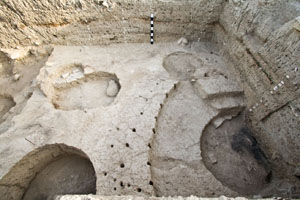 The Phase 6c post-holes
The ceramics indicate that this Phase 6 is approximately contemporary with the later phases of the Stele Building (IIc/d). It may not be coincidental that the Eastern Building there was not rebuilt in phase IId, leaving an open space, and over this, spreading west to the space immediately overlying the destroyed eastern rooms of the IId Stele Building (Rm d5) there was a surface with numerous post-holes.
In K14a and the west half of K14b our excavations were taken down below Phase 6 only in the space to the west of the post-hole ring. Here there was a tight sequence of occupational phases (Phases 7 down to 15), associated with the eastern side of a building that was either part of or contemporary with the Level 3 Late Bronze Age house which lay beneath the Iron Age house in I14.
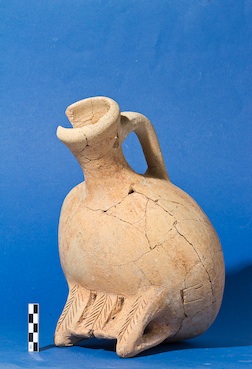 Pilgrim flask with stand