 |
 |
|
|
Kilise
Tepe measures about 100m by 100m. It was gridded into 10m squares and
the quantitative distribution of sherds and stones on the
top of the tepe was recorded, during surface
clearance. Sherds from the Chalcolithic to the Byzantine periods
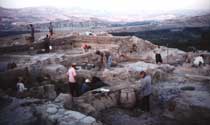
were collected. Excavations took place in two main areas. A major fortification
wall, probably belonging to the Iron Age was located on the east side,
while excavations at the north
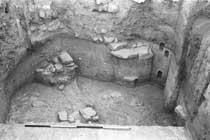
west end of the tepe uncovered several phases. These included very
shallow walls dated to the Byzantine period and a series of clay lined,
bell shaped pits cut into a building of mud brick. The first phase of the
building was built on a stone foundation, and the final phase was destroyed
by fire. The date of its occupation was unclear. Middle and Early Bronze
Age levels were reached in an old robber trench converted into a 'deep
sounding'. |
 |
The
surface clearance programme was extended onto the flanks of the tepe
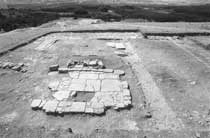
and completed. Excavations in the north and east continued, and new
areas were opened, in a successful attempt to locate the church.
Walls of a late Bronze Age structure, with 'imperial Hittite' pottery,
were
also uncovered. A Leverhulme Trust funded
project, directed by Dr Colledge, was started. It entails a systematic
programme of sieving and flotation of selected deposits to provide
quantitative data on the use of urban space for comparison with similar
data from Tell Brak in Syria. The report is available through Archaeology
Data Service.
|
 |
Excavations
concentrated on the Bronze Age levels and the large, mud-brick, Iron
Age building. A good cultural sequence from Early Bronze II to Late
Bronze Age, including a Middle
Bronze Age room with a clay hearth, was found in the deep sounding.
Among the thick destruction debris of the Iron Age building were storage
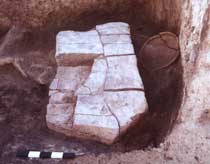
jars containing carbonised botanical remains (including einkorn). A fractured
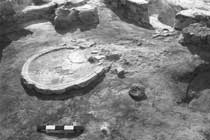
'stele' (see photo) with traces of red paint was also found in a central
room of this Iron Age building; this room had a large, central hearth.
Two
stone-lined
pits / kilns, one containing large quantities of Iron Age pottery with
8th-7th century parallels in Cyprus, were found stratified above what
became known as the 'Stele Building'. |
 |
A
detailed plan of the Byzantine
church was made, after most of its outline had been exposed. Two
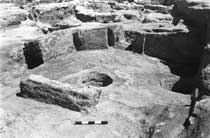
major phases were identified. Excavations to the south of the 'Stele
Building' yielded a good sequence of Late / Middle Iron Age pottery
and a south wall to the 'Stele Building'. Thus, the majority of the
plan
of the 'Stele
Building' (18m N-S by 14.2m E-W) and its 8 or 9 rooms has now been
uncovered - the number of large storage jars (13 in situ jars
have been found so far) and organic remains (lentils, barley and olive
stones) among the destruction debris suggest the building's probable
function. The Early Iron Age / Late Bronze Age transition continued
to be investigated and bedrock, with Early Bronze Age architecture
and artefacts
lying directly on it, was reached in the deep
sounding. |
 |
The
1998 season sought to consolidate upon the findings of the previous
four seasons, as the project moves towards the publication stage. Excavations
concentrated on exposing more of the Byzantine church and clarifying
its architectural phasing, completing the plan of the Iron Age 'Stele
Building'
and expanding the area of the deep sounding, thus increasing the assemblage
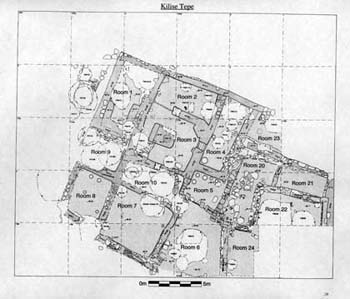
of Early Bronze III material from it. The west end of a further sizable
Iron Age building was uncovered to the east of the 'Stele Building' (see
plan). A series of samples were taken for dendro-chronological dating
by Prof.
Peter
Kuniholm; Dr Jan Driessen took some aerial photographs of the site and
Dr Tim Reynolds catalogued the lithic assemblage. Much progress was
also made with the analysis of the pottery, small finds and bones.
At the end
of the season, all the finds from Kilise Tepe were moved to a storeroom
in Silifke Museum. |
 |
The publication of the results of the five years of excavation and study of Kilise Tepe is at an advanced stage. The two-volume report will include the definitive account of the surface survey and the excavated areas, and the publication of the principal finds of all periods. The Projects database and other documentation of more specialist interest will be archived with the Archaeology Data Service.